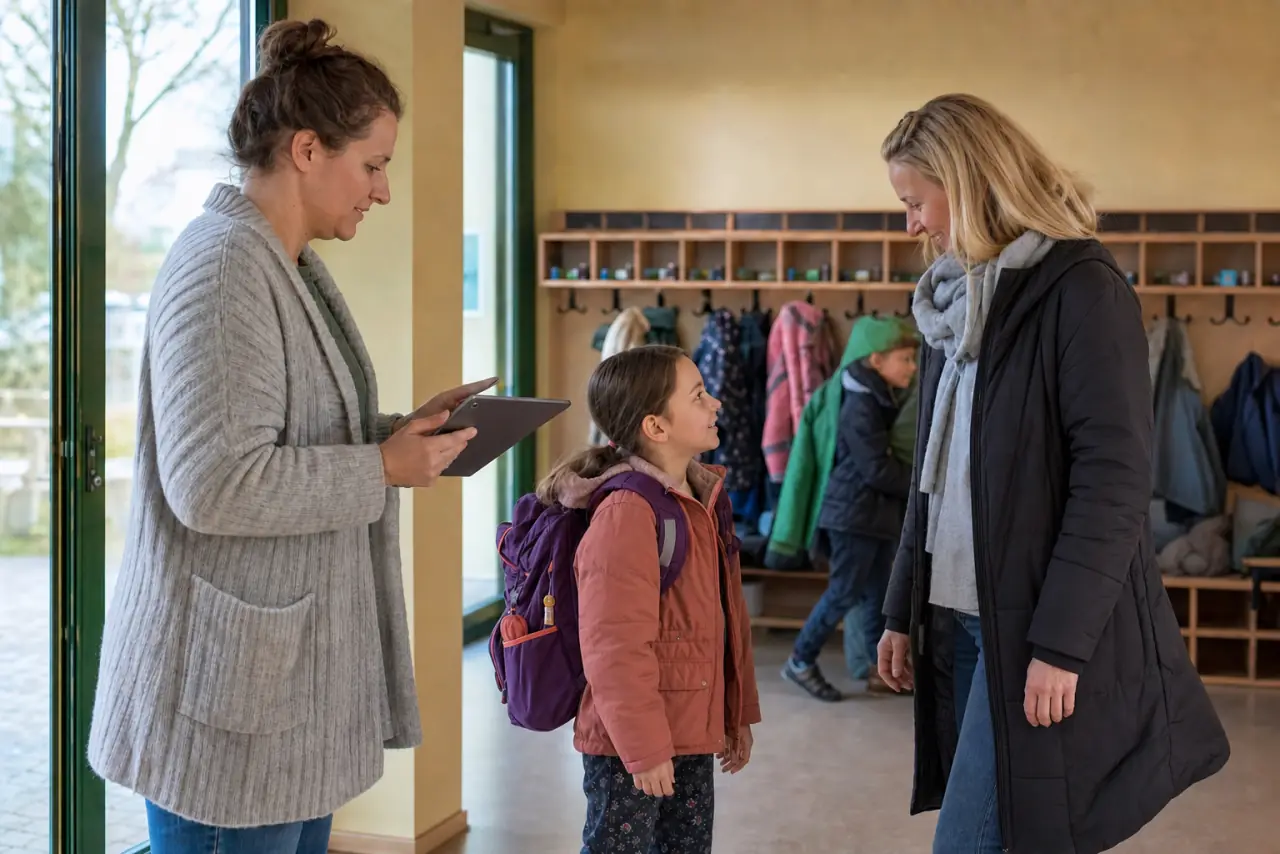
Tuesday, 3:20 pm: a child is waiting at the exit for their grandfather. The child's record lists the mother as an authorised pick-up contact, while a note for today names the grandfather. At the same time, a colleague remembers a message saying the child should walk home alone. The situation is an example, but it shows why authorised pick-up in after-school care has to be more than a name on a list. Your team must be able to see which information applies, for which day it applies and who has checked it.
Pick-up times and pick-up authorisations belong together, but they are not the same thing. The pick-up time answers when a child leaves. The authorisation answers who the child may leave with. Then there is going home alone, if that has been agreed for a child. A reliable process keeps this information separate and brings it back together at pick-up.
Pick-up times follow local rules
There is no pick-up time that suits every school. In Germany, for example, open all-day schools (OGS) in North Rhine-Westphalia (NRW) follow a state decree (in German), in force since 1 August 2026, which usually requires children to attend until at least 3 pm. Parents are expected to give timely notice if they want their child excused. Who decides on short-notice exceptions is set out in the cooperation agreement between school and provider.
In practice, the school and the provider need their own clear rules. They define which regular pick-up times apply, how exceptions are reported and what happens if a message arrives late or is unclear. Parents and staff should know the same version of these rules.
Separate permanent authorisation from changes for today
Many follow-up questions arise because a long-term arrangement and a one-off change sit on the same list. A clear separation works better:
- Permanent: Who is generally allowed to pick up the child?
- Regular: Which pick-up time applies on a particular weekday, and how does the child get home?
- Today only: Who is picking up the child on this date, when does the child leave, or may the child go home alone as an exception?
- No longer valid: Which earlier authorisation has been withdrawn or replaced?
Organise authorised pick-up in six steps
- Write down the basic rules: Decide which pick-up times apply, through which channel changes arrive and who may check them. Also describe how you handle messages that arrive after your deadline.
- Keep the baseline up to date: Record the people with permanent pick-up authorisation, how the child usually gets home and the regular pick-up times. Check this record at the start of the school year and whenever parents report a change.
- Make same-day changes unambiguous: A change needs at least the child concerned, the date, the new pick-up time or person and a way to ask questions. A message like "earlier today" is not enough without a time.
- Decide who checks the information: Define who accepts new information and when it counts as checked for care staff. That way, not every member of staff has to clarify the same case again.
- Define the moment of pick-up: Staff compare the person collecting the child with the current record. If the person is unknown, an agreed form of identity check is needed. If anything remains unclear, the child is not handed over until the site manager or another responsible person has resolved it.
- Review exceptions afterwards: If a change came too late, was incomplete or arrived through the wrong channel, discuss at the end of the day how the process can be improved. The next shift should not have to clarify the same case again.
How moto brings pick-up information together
In the Staff app from moto, care staff can see the pick-up time, how the child gets home, contacts and authorised pick-up contacts for each child. They can find a child by name, class, group or room and open the information where it is needed during the day.
Depending on the setup, parents can use the Parent app to change pick-up times and keep contacts and authorised pick-up contacts up to date. Your site receives the information in the right context and can act on it. Roles and permissions control who may see or change which areas.
moto does not replace local pick-up rules and does not decide whether a special authorisation is legally sufficient. The platform keeps the agreed information together. Which messages are accepted, who checks them and how an unknown person is identified is decided by the school and the provider. These decisions also belong in the joint setup of the platform.
No second list next to the current record
A digital solution only helps if the team knows which record is binding. If a folder in the office, a note on the group room door and a chat message stay in use as well, the search starts all over again. So plan a short transition period and then stop keeping the main list alongside it.
The article Digital attendance in after-school care shows how a shared daily record comes about. Pick-up adds one more step: attendance turns into an agreed way of going home or a handover to the person who is currently authorised.
Frequently asked questions about authorised pick-up
How can parents report a changed pick-up time digitally?
Depending on the setup, parents can use the Parent app to change pick-up times and keep authorised pick-up contacts up to date. Your site receives the information in the right context and can act on it. The change no longer has to be copied from a note or message into a second list.
Which pick-up information does the team find in moto?
In the Staff app, care staff see the pick-up time, how the child gets home, contacts and authorised pick-up contacts for each child. They can search for the child by name, class, group or room. This way they find what they need right on the child's record instead of searching several places.
Does moto decide whether a person may pick up a child?
No. moto brings the stored information together and makes it accessible according to the roles and permissions that have been set up. Which pick-up rules apply, who checks changes and how an unknown person is identified is decided by the school and the provider.
Conclusion
Reliable pick-up starts with a simple distinction: what applies permanently, what applies regularly and what applies only today? When parents have a clear way to report changes, the site manager checks them and staff at the exit see the current record, pick-up times and authorisations become manageable. The rules remain the responsibility of the site. The digital platform makes sure the information behind them is not spread across several lists.